

This is a question with definitely no simple answer, as the dynamics of both the fashion industry and the national and international media landscape are vast. To evaluate the current relevance and future viability of the fashion show as a tool, it helps to look back at its past.
As early as 1860, the first collections were presented in Paris. Charles Worth, widely considered the father of Haute Couture, was also the first designer to move away from mannequins, preferring real people to present his collections. This idea caught on internationally in the following century. Paul Poiret took it a step further by experimenting with unusual locations and choreographies. Until World War II, shows in this format were continued by the likes of Coco Chanel and Elsa Schiaparelli.
Across the Atlantic, the first “Press Week”, known today as Fashion Week, took place in the Big Apple in 1943. Eleanor Lambert, the press spokeswoman for the Dress Institute, founded New York Fashion Week that same year. The institute invited 150 fashion journalists from across the country to New York for a week, and 56 attended. The implementation of Fashion Weeks established a distinct rhythm, bundling the presentations so that journalists, buyers, influencers, and celebrities could attend all the major shows within a single week.
Milan followed in the 1950s, and Paris in 1973 with the legendary “Battle of Versailles”. In this competition between five French designers (Yves Saint Laurent, Emanuel Ungaro, Christian Dior creative director Marc Bohan, Pierre Cardin, and Hubert de Givenchy) and five American guest designers (Bill Blass, Oscar de la Renta, Anne Klein, Halston, and Stephen Burrows), the talents pushed each other to new heights, with the American guests ultimately coming out on top. London followed in 1984, while the German capital didn’t get its own Fashion Week until 2007. The sources for this section include the AMD blog and Vogue.de.
Here, I would like to showcase the most iconic fashion shows of all time that have sparked a special passion in me. The following list is purely based on my personal impression and does not claim to follow objective criteria. The selection is presented in chronological order and will be continually updated and expanded.
Schiaparelli Haute Couture Spring/Summer 2023 “Inferno” by Daniel Roseberry
Iris van Herpen Haute Couture Spring/Summer Collection 2020 “Sensory Seas”
Versace Women’s Spring/Summer 2018 by Donatella Versace
Alexander McQueen Women’s Spring/Summer 2001 “Voss” by Alexander McQueen
Thierry Mugler Haute Couture Fall/Winter 1995
But Where Do Fashion Shows Stand Today?
Particularly due to the rapid spread of the internet, fashion, trends, and subsequently fashion shows became accessible to the general public. Where people once eagerly awaited updates from traditional media like television, magazines, or radio, there is now an expectation to receive information instantly, with zero delay. As a result, major brands livestream their fashion shows on free platforms like YouTube or Instagram. Influencers also provide documentation of the events with barely any delay, keeping pace in real time.
In fact, the Handelsblatt reported in 2019 that influencers account for 49% of a brand’s media impact, while traditional media only achieve a 32% share. Among the most prominent influencers are figures like Chiara Ferragni, Leonie Hanne, Caro Daur, and Chriselle Lim. These figures are based on a study by Launchmetrics. According to Handelsblatt, the data analytics platform evaluates the audience response to around 400 fashion shows in London, Paris, Milan, and New York, taking into account online and print media, as well as statements from influencers and celebrities.
Driven by the accessibility and speed of the World Wide Web, along with the power of influencers, fashion shows are experiencing a resurgence—or perhaps we can even call it a comeback?
But then came a turbulent time, triggered by the Covid-19 pandemic. Large-scale fashion shows were unable to take place, and the trajectory of the pandemic, along with its accompanying restrictions, was incredibly difficult to predict. In a panel discussion with Balmain‘s Olivier Rousteing, Chloé‘s Natacha Ramsay-Levi, and Balenciaga‘s Cédric Charbit, Vogue explored the question: “Do fashion shows have a future?”
At the start of the discussion, Charbit made a clear distinction between guests and viewers. For instance, only about 600 guests are invited to a Balenciaga show. However, when adding up the viewers streaming on YouTube and Instagram, alongside posts on X (formerly Twitter) and stream replays, the show reaches an audience of approximately 10 million viewers. While Ramsay-Levi agreed that the largest audience is found online, she argued that live shows are unique events that truly spark inspiration and set conversations in motion.
“There is a human dimension to it that I absolutely want to retain.”
Natacha Ramsay-Levi of Chloé
The discussion then drew a parallel to the music industry, noting that live events like concerts and festivals are just as vital as the digital availability of music. The panel predicted that the industry is only at the beginning when it comes to uniting technology and fashion. Ultimately, the tone was one of optimism, though it became clear that one must keep a close eye on the industry’s dynamics and remain open to new formats.
Additionally, in its “The State of Fashion” 2023 report, The Business of Fashion explains that a significant portion of luxury spending in the Middle East during the pandemic could be attributed to the fact that luxury consumers were unable to travel to Europe. Post-pandemic, approximately 60% of luxury spending is now happening domestically. Alongside opening new stores, luxury brands are finding other ways to establish a presence in Middle Eastern markets. Examples include hosting local fashion shows and creating local content by collaborating with Middle Eastern artists for regional collections and photoshoots. To penetrate markets and boost sales in a specific region, the medium of the fashion show seems to be absolutely essential.
In my opinion, fashion shows as events—as a gateway to the brand—are an essential tool for evoking emotion. Furthermore, viral moments on social media play a crucial role. Probably the most striking example from 2022 is the Parisian fashion brand Coperni: for their Spring/Summer show at Paris Fashion Week, they used a sprayable, liquid fiber to spray a dress directly onto model Bella Hadid. WWD reported on a study by Launchmetrics, which estimated the Media Impact Value (MIV) of this moment at 26.3 million US dollars, with 20.9 million US dollars generated purely on social media. The calculation of this value is based on online posts, interactions, and articles.
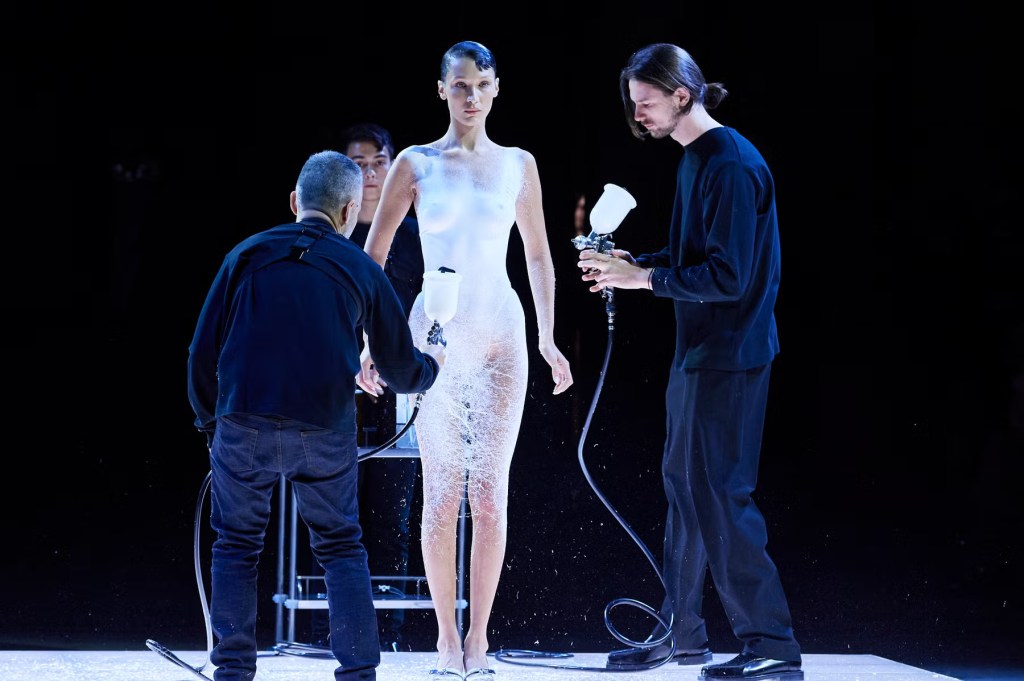
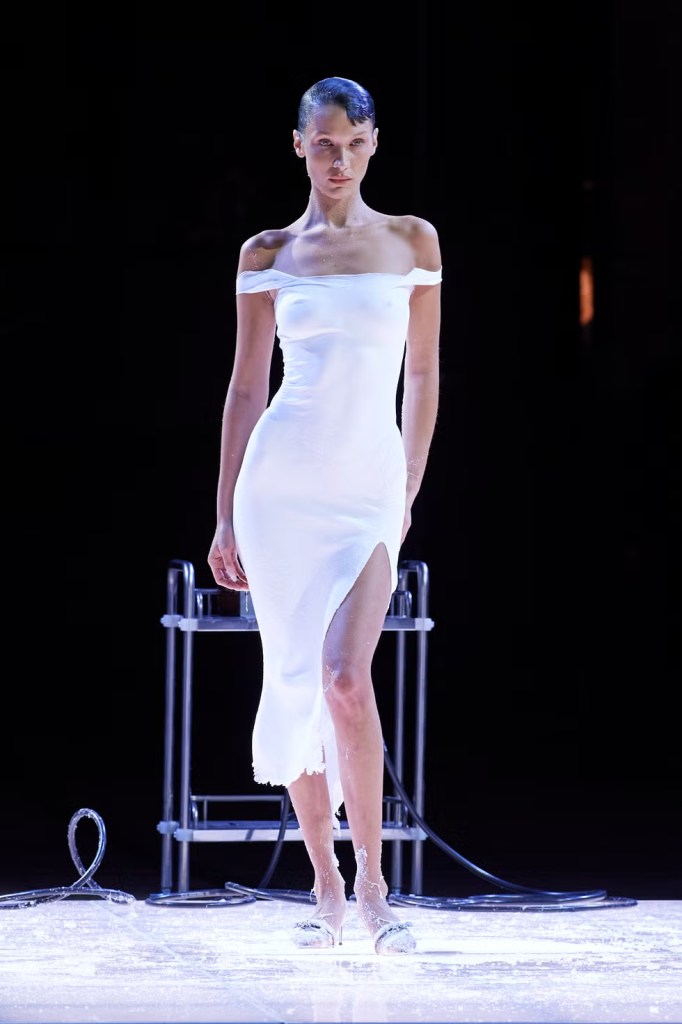
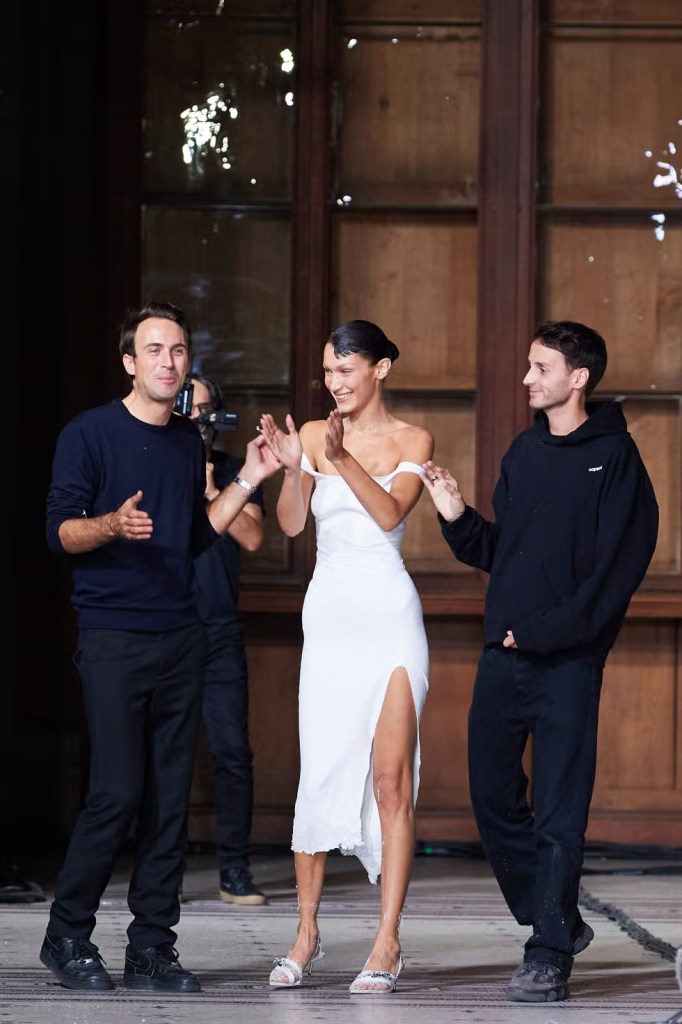
This final example demonstrates that fashion shows remain highly relevant, from both an economic and an emotional standpoint. Having had the privilege of experiencing shows in Berlin, Paris, Milan, and Amsterdam firsthand, I can only give this argument even greater weight.
In this drive for recognition and attention, there are also some bad apples who know few, if any, boundaries. A prime example is the label Shao, which hosted a fashion show at the home of con artist Anna Delvey on September 11, 2023. Anna Delvey (whose real name is Anna Sorokin), who became famous for scamming the New York elite, co-hosted the premiere of Shao’s fashion show, according to The New York Times via Instagram.
I dare to argue that the importance of a show’s entertainment value has grown, as audiences become increasingly inclusive, shifting the runway from an exclusive expert-only affair to a mainstream mass event. The streaming viewership numbers and subsequent clicks point to a successful transition so far, yet it is one that undoubtedly demands a critical eye in certain areas. I am excited to see what the future may bring!
Update December 2023:
At the end of the year, Vogue Business published the leading fashion shows measured by Earned Media Value. Generally speaking, Earned Media Value is the monetary worth of the attention and exposure generated through third-party websites, social media, or traditional media channels. The top shows are highlighted in the following post.